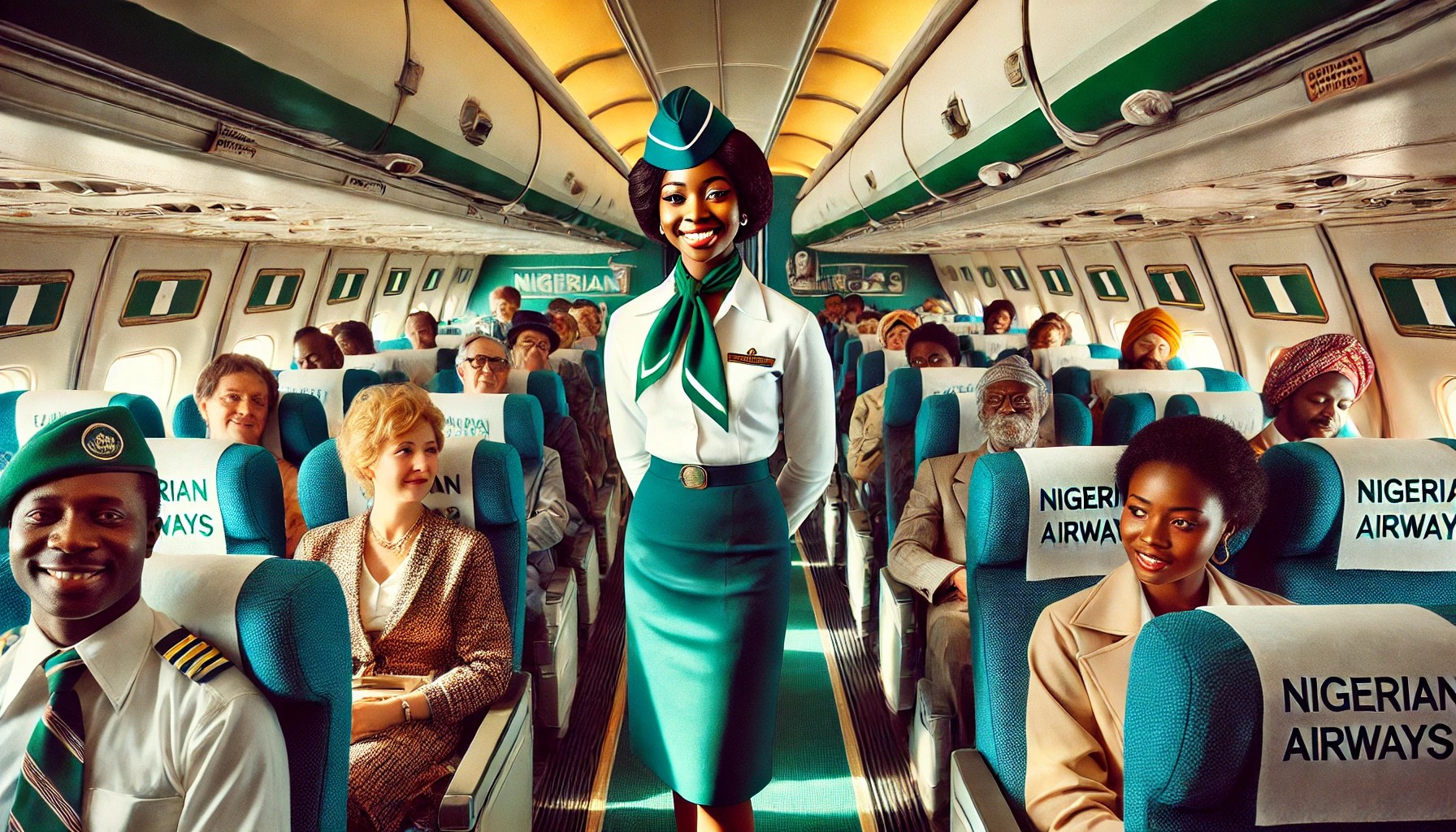
Working as an air hostess, as it was called when I joined Nigerian Airways, the air hostess career was once considered a glamorous and high-risk job. It was also associated with a lifestyle of elegance and excitement. I worked as a cabin crew member with Nigerian Airways for several years before traveling abroad to further my education. The American system classifies it as Cabin Crew; I later worked for two major American Airlines after I left Nigeria. In any case, back to my story of being an Air Hostess with then Nigerian Airways.
My main goal back then was to eventually attend university and graduate, a dream that my work with Nigerian Airways helped me pursue. Thanks to my job, I had the chance to travel across Nigeria, various African countries, and even internationally—opportunities I might never have had otherwise. I met several influential people on these flights, including M.K.O. Abiola and Reverend Jesse Jackson, both of whom I served on flights from Lagos to New York. I also met several high-profile Nigerian ministers, making each flight an unforgettable experience.
Being an air hostess was both thrilling and challenging, especially as a young woman. This narrative focuses on how I joined the airline, and the steps involved in becoming an air hostess.
Though my story isn’t entirely chronological, I hope to make it as clear and captivating as possible, sharing an experience that might inspire readers and listeners alike.
Life Before Nigerian Airways
My name is Bess JT; formerly Blessing Otobo, and I was born in Lagos, though my family is originally from Rivers State. Growing up in Port Harcourt, I dreamed of becoming a flight attendant as a teenager, nurturing this desire privately. The dream became more vivid when I got a part-time job as a cashier at a boutique in the Port Harcourt Airport Hotel. From there, I would often watch airline crews checking into the hotel after their flights, imagining myself someday working on a plane and traveling as they did.
One of my cousins on my mother’s side worked as a cabin crew member with Nigerian Airways. Occasionally, she would fly into Port Harcourt and visit my mother, her aunt, in her uniform. Her visits heightened my aspirations, especially when I’d catch a hint of her perfume—a scent that, to me, became synonymous with the glamour of air travel. Years later, I learned that her perfume was Aromatic Elixir by Clinique. Eventually, I began wearing it myself, buying it at London’s Selfridges during one of my many flights to London as a cabin crew member.
Becoming an Air Hostess: Requirements and Application Process
The path to becoming an air hostess, as it was called before titles like “cabin crew” or “flight attendant” took hold, involved meeting specific requirements. Prospective candidates needed at least a high school diploma (a university degree was a plus but not mandatory). Applicants also needed to be unmarried and not pregnant, with traits like friendliness, confidence, and flexibility with their time. Fluency in English was essential, along with some knowledge of languages like French, as many Nigerian Airways destinations included French-speaking regions in West and East Africa. Additionally, Nigerian Airways followed a quota system, hiring a certain number of candidates from each state, with some states like Lagos and northern regions having larger allocations.
In 1985, I applied and eventually secured a position with Nigerian Airways, officially joining the crew that year.
The Journey to My First Airline Job
After high school, despite passing my WAEC exams with decent grades, I couldn’t enter university due to financial constraints. I was deeply disappointed, as education was a goal I was determined to achieve. Driven to help my mother financially, I began searching for jobs in local newspapers. Eventually, I found an advertisement in the *Tide Newspaper*, which promised a cabin crew position with an international airline. Excited, I told my mother, who reluctantly provided me with a ticket to Lagos, while my father refused to support the idea.
When I arrived in Lagos, I paid a fee for what was advertised as a “training program” to prepare me for work with an international airline. However, it quickly became clear that this was a scam. When I returned to the office to check my supposed exam results, I found the door to the office and the exam results locked and abandoned. I felt both heartbroken and betrayed, as I’d hoped this opportunity would help me support my family.
With no other immediate options, I stayed in Lagos with my cousin, who kindly let me stay at her flat in Ikeja. Yet, life in Lagos was difficult. I realized how tough it could be for someone without connections. During this period, I encountered several dangers, including an incident where a young woman I met offered to introduce me to influential people who could help me secure a job. One night, she arranged for us to meet an Air Force officer and a general in the Air Force at a guest house. When she left me there alone, I realized I was in an uncomfortable and potentially unsafe situation, and I quickly found my way back to my cousin’s flat.
Reflecting on My Journey
These early experiences—both good and challenging—shaped my journey into adulthood. Despite the setbacks and the difficult lessons, they ultimately strengthened my determination to achieve my dreams. Working with Nigerian Airways allowed me to fullfil one of those dreams, offering me the adventure and independence I’d longed for since I was a teenager in Port Harcourt.
My journey was far from easy, and not without its share of pain and hardship, yet each step brought me closer to realizing my aspirations. I hope that my story inspires others who may be facing their trials to keep pursuing their dreams, no matter the obstacles.
The general never provided the promised job or recommendation. I first arrived in Lagos that December, fresh out of high school, hoping to start university. But with my plans for university admission delayed, I felt compelled to take matters into my own hands and set out to Lagos on my own. At 18, I was still naive and lacked guidance. In hindsight, perhaps I should have heeded my father’s disappointment about my plans, though he offered no alternative for university or employment.
After months in Lagos, moving aimlessly from one failed opportunity to another, I felt defeated. I finally returned to my parents’ home in Port Harcourt in May of 1985, exhausted and ready to abandon my dream of working as a cabin crew member. The entire experience left such a sour taste that I could hardly stand to look at the Nigeria Airways sign in Aba road or in Town where they had their offices upon my return from Lagos.
Desperate for a job, I wondered who might help me. A neighbor, a young girl who lived close by, mentioned a revered priest named Father Eleh who held mass prayers. She suggested I could pray for help in finding a job, as her cousin’s daughter with sickle cell anaemia had been taken there by her mother for healing prayers. Though I wasn’t Catholic, I was willing to try anything, so I joined her and her aunt on a visit to Father Eleh’s sanctuary.
At the sanctuary, I waited to meet Father Eleh, and eventually, I did. He prayed for me and advised me to fast for three days, avoiding meat. He assured me that afterward, I would find a job. I returned home, completed the fast, and held on to his words. Several weeks passed with no success, and I began feeling disheartened. Then, unexpectedly, I felt a strong inner prompting—a distinct thought that seemed like the voice of God—urging me to visit the Nigerian Airways building on Aba Road in Port Harcourt and ask to speak with the manager about cabin crew hiring.
Although I felt anxious at the idea of approaching an airline office after my ordeal in Lagos, I followed the prompting and went to the building on Waterline Junction on Aba Road. When I arrived, I asked a gatekeeper about seeing the manager, and to my surprise, he led me directly to the manager’s office. There, I recognized the manager as Joe, the husband of a distant relative. After introducing myself, I explained why I was there, and Joe informed me that Nigerian Airways would indeed be hiring the following week. He advised me to arrive early if I wanted a chance.
I made sure to arrive promptly on the day of the open call. The line was enormous, stretching down Obasanjo Road and Aba Road, packed with people hoping for a chance to join the cabin crew team. After waiting hours, it was finally my turn around 4 p.m. I went through an interview conducted by three senior pursers and one administrator. I remember a particular woman from then Cross River State, her face etched in my memory to this day. They asked me questions about my background, my age, and where I was from, along with several job-related questions.
After the interview, Mrs. Jimoh, one of the interviewers, assured me that I would receive a letter within two weeks with their decision. I waited, but no letter came. I returned to the Nigerian Airways office, hoping to find Joe. When I explained the situation, he looked surprised and promised to investigate. He asked me to come back the next day.
When I returned, Joe informed me that three candidates had been selected from Rivers State under the company’s quota system, but that one candidate had decided to decline the offer to return to university. However, he cautioned that he could not personally finalize my hiring; I would need to travel to Lagos and meet the Personnel Director to plead my case directly. The thought of returning to Lagos filled me with dread, but I decided it was worth a try.
There was, however, one pressing issue: I had no money for the trip. My mother refused to help, recalling the expense of my previous trip. At that moment, I remembered Evans, a young man I’d met through my sister. He had given me his business card sometime before, and I decided to reach out to him. Evans was in Aba, and when I explained my situation, he offered to help. I traveled to Aba to meet him, and he generously provided the money for my flight ticket to Lagos.
With Evans’ help, I bought a one-way ticket to Lagos the next day, prepared to advocate for myself and secure the opportunity I had worked so hard to pursue, despite all the challenges I had faced along the way.
When I arrived at the airport, I boarded the first flight to Lagos. After the usual announcements, I found my seat—either by the window or in the middle. I vividly remember a young man seated beside me who was quite intent on striking up a conversation. At that time, I wasn’t in the mood for socializing, especially with men, due to my previous experiences in Lagos. Though he asked my name and seemed friendly, I kept my responses brief and polite, hoping he’d lose interest. At the end of the flight, he handed me his business card, mentioning he’d be staying at the Hilton Hotel in Ikeja, and invited me to visit. I accepted the card primarily to end the conversation but didn’t think I’d ever see him again. Little did I know that the card would soon become crucial.
Once we landed at the Lagos domestic airport, the Nigerian Airways crew made their final announcements, though I can’t recall the details. After the plane stopped, I grabbed my bag and exited the aircraft, with the young man trailing behind. I tried to distance myself, as I didn’t want any distractions. Joe, my contact in Port Harcourt, had advised me to go to the Nigerian Airways personnel department, but I hadn’t thought to ask him for specific directions. Back then, I was inexperienced and a bit shy about asking too many questions, especially to someone in a high position. I knew I needed to find the personnel department, but navigating the airport was confusing, and I was unfamiliar with the layout.
I started asking for directions, and, after being sent from one office to another, I finally found someone who directed me to the correct department. Along the way, I encountered a man named Mr. Alabi, who, unfortunately, seemed more interested in taking advantage of me than helping. I managed to avoid him, and, with another young woman I’d met who was also looking for the same office, we eventually found the director of personnel (DOP), the official in charge of hiring for the cabin crew.
We explained our purpose to the messenger at the DOP’s office, and he instructed us to wait outside. This was the beginning of a three-day ordeal. We waited outside the office all day, only to be told at around 4 p.m. that we’d need to return the next day. By this time, I was hungry, as I hadn’t eaten anything since breakfast on the plane. Unsure where to go or where to stay, I suddenly remembered the business card the young man on the flight had given me. There was a reason for everything, I thought. I told my new acquaintance about him, and we made our way to the Hilton Hotel in Ikeja.
At the hotel, I introduced myself to the receptionist, who informed the young man that we were there. He welcomed us, and when I explained my predicament, he offered to let us stay in his room. He offered his bed, but I declined, insisting that we sleep on the floor. My companion initially wanted to take the bed, but I quickly claimed a spot on the floor, leaving her no choice but to join me. The next morning, after thanking the young man profusely for his help (though he seemed disappointed we hadn’t stayed in the bed), we returned to the DOP’s office.
On the second day, we waited again, but once more, the director was too busy to see us, and we were asked to leave by late afternoon. I felt discouraged but determined not to give up. I was in Lagos for a reason, and I wasn’t leaving without a job as an air hostess. My companion suggested a place where we could spend the night, though it wasn’t the most comfortable. We spent the night there, and by morning, we were back at the DOP’s office, waiting once again.
By the third day, my resolve was waning. I hadn’t had a proper meal in days and was exhausted. Around noon, I saw Joe, the manager from the Port Harcourt office, approaching. I couldn’t believe it. He seems to be heavenly sent. He recognized me and asked if I’d seen the DOP yet. When I told him I hadn’t, he looked shocked. Without a word, he went into the DOP’s office. A little while later, the messenger came out with a grin, holding two envelopes, one for me and one for my new friend.
I opened mine right there, my heart pounding as I read the words on the letter. It was an offer letter for an Air Hostess position with Nigerian Airways, complete with instructions for the training that would begin in January 1986 in Ikeja. The letter also provided details on where I would be staying during training, with accommodations and meals covered. Additionally, I received a return ticket to Port Harcourt to gather my belongings and prepare for the training.
That moment was one of the most joyful and fulfilling experiences of my life.
Before receiving that offer letter, I had felt utterly hopeless and couldn’t have imagined a better resolution to my challenging experience in Lagos. If the offer hadn’t come through, I truly don’t know how I would have made my way back to Port Harcourt, though, at the time, I hadn’t even thought that far.
I spent several days at the hotel, enjoying my room and bed. As instructed, I ordered meals, and soon after, I visited the ticketing department to collect a round-trip ticket to Port Harcourt and back to Lagos. This marked the beginning of my remarkable journey as an air hostess with Nigerian Airways. After two weeks, I returned to Lagos and began my training. We were later relocated to Ilorin in Kwara State for intensive training, earning our group the nickname “Kwara 86.” After six weeks, we completed our exams, became certified as air hostesses, and returned to Lagos to settle into our assigned accommodations.
My first flight was to Libreville in Gabon, one of the West African routes, considered a semi-international flight. As a junior crew member, I worked alongside a team of experienced crew members. I continued with Nigerian Airways, even traveling to New York, a route typically reserved for senior crew. For reasons I still don’t fully understand, our group, Kwara 86, was assigned several international flights within my first year. I enjoyed my work with the airline, but my ultimate goal was to return to university.
After several years of flying and traveling, I left Nigeria for the UK and, eventually, the USA to pursue my education. I went on to earn an associate’s degree, a bachelor’s, a master’s in arts, and later an LLM in Human Rights Law. My experience with the then-Nigerian Airways gave me invaluable exposure, making the transition to studying abroad much smoother. Since then, I have written several published books, which are available on Amazon.com.
Working with Nigerian Airways was an incredible and unforgettable experience, one that has shaped my life in countless ways.
Listen to the audio version of this article below.
https://murf.ai/embeds/index.html?embedId=m3d7hyvk
https://blessinbess.bandzoogle.com/single/125573/i-believe-you-can-find-love
https://blessinbess.bandzoogle.com/single/125573/i-believe-you-can-find-love

